📍 Location & Significance
-
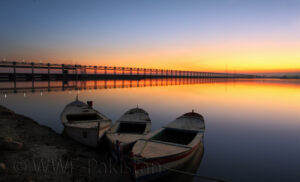
The barrage spans the Indus River about 16 km northwest of Kot Addu and 20 km southeast of Taunsa Sharif.
-
Constructed between 1952 and 1958, it serves vital roles in irrigation, flood control, and as a multi-utility crossing for roads, railways, pipelines, and power lines .
-
With gates that can discharge up to 1 million cusecs, it’s a critical water-regulation structure .
🌾 Irrigation & Agriculture
-
Feeds over 2.35 million acres (950,000 hectares) of farmland across Muzaffargarh, D.G. Khan, and Panjnad canal systems .
-
Supports key crops including cotton, sugarcane, wheat, and fodder, sustaining livelihoods across southern Punjab.
🐾 Ecological & Environmental Role
-
Declared a wildlife sanctuary in 1974, and designated a Ramsar Wetland of International Importance in 1996 due to its rich biodiversity .
-
Habitat for endangered species such as the Indus River dolphin, hog deer, various fish, waterfowl (ducks, cranes), reptiles, otters, and aquatic plants .
-
In 2015, the government and WWF-Pakistan launched a Rs 110 million management plan to conserve habitat and promote eco-tourism .
🛠️ Infrastructure & Rehabilitation
-
The barrage features 65 gate bays over a 4,346 ft (1,325 m) span .
-
In 2003, the World Bank funded a $123 million rehabilitation project, addressing ageing infrastructure and structural erosion .
-
Ongoing modernization aims to strengthen embankments, install remote-controlled gates, and improve safety systems.
⚠️ Flood Control & Challenges
-
The barrage plays a key role in flood management but has been criticized after the 2010 floods, with some blaming insufficient height and erosion measures .
-
It’s considered a high-priority project for rehabilitation to ensure food and water security for millions in the command area .
🌐 Multiple Uses
-
Road & rail bridge: Key connector for vehicular and train traffic across the Indus near Kot Addu.
-
Utility crossing: Supports gas, oil pipelines, telephone lines, and high-voltage electricity transmission .
-
🚧 Local Impact & Future Prospects
-
Irrigation lifeline: Kot Addu’s farmers rely heavily on the water distributed via barrage-fed canals for crops like wheat, cotton, and sugarcane. Any failure or breach could directly threaten agricultural productivity and livelihoods.
-
Eco-tourism & recreation potential: Plans are in place to develop a 20-acre recreational park along its banks—complete with parking, camping, boat safari, fishing, and perhaps a historic “Indus Queen” riverboat exhibit.
-